Beyond the To-Do List: Building a Strategy That Actually Wins


Mr. Roy
Published 3 months ago
Discover curated collections of blog posts
Mr. Roy
Published 3 months ago
Strategic Writer
A technology and business leader with a strong focus on digital transformation, software delivery, and strategic growth. Experienced in leading JavaScript-focused teams, driving business development initiatives, and building innovative SaaS products. Passionate about AI-powered solutions, product development, stakeholder management, and creating scalable digital platforms. Skilled at bridging the gap between business objectives and technology execution while fostering collaboration across clients, teams, and partners.
Get personalized recommendations based on your reading history and interests. Visit the Member Dashboard to see blogs tailored just for you.
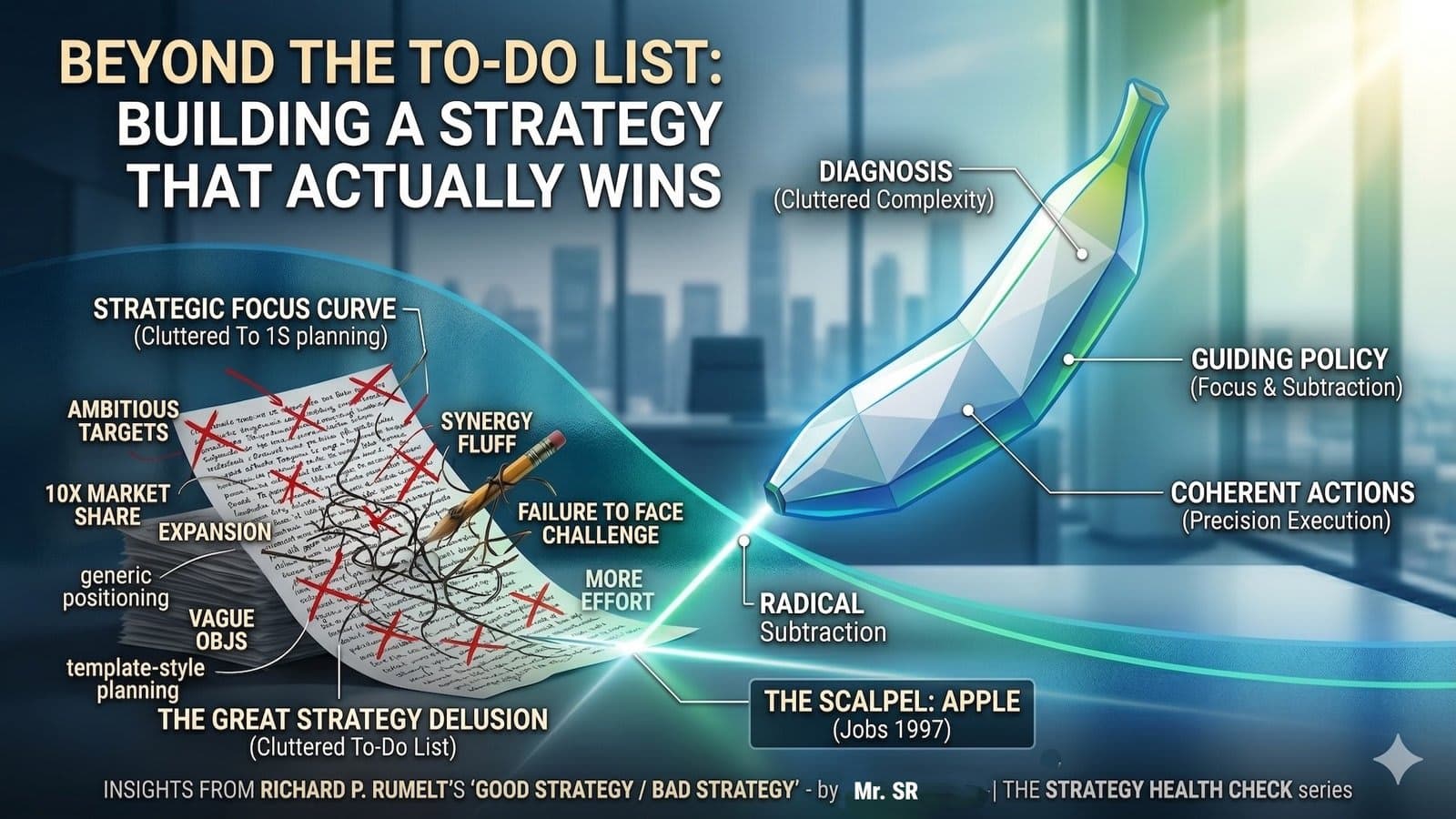
The most common mistake in modern leadership is something we can call the "Great Strategy Delusion"—the comfortable belief that high-energy ambition, big numeric targets, and positive thinking are acceptable substitutes for hard, realistic analysis.
Anchored in the foundational frameworks of Richard P. Rumelt’s acclaimed masterwork, Good Strategy / Bad Strategy: The Difference and Why It Matters, this article cuts through the corporate noise to look at the raw mechanics of organizational success.
Walk into almost any corporate boardroom, non-profit planning session, or government agency, and you will find the same pattern. Leaders routinely point to a thick stack of colorful slides filled with aspirational goals, aggressive timelines, and detailed to-do lists, and proudly call it a "strategic roadmap".
But as Rumelt powerfully argues, this reveals a massive misunderstanding of what a strategy actually is. Strategy isn't about daydreaming or shouting large growth numbers into the universe. True strategy is born from deep insight. It is the ability to look at a complicated, messy environment, identify the hidden levers of power within it, and build a highly specific, coordinated response to overcome a clearly defined challenge.
If your current strategic plan reads like a long grocery list of wishes, it isn’t a strategy. It is an expensive, stressful distraction.
Before we can build something that works, we have to learn how to spot what is broken. Bad strategy leaves unmistakable clues behind. If you look closely at your organizational planning documents, watch out for these four warning signs:
Pure Fluff: This is the heavy use of trendy buzzwords, vague mission statements, and over-complicated corporate jargon. Fluff is a defense mechanism. It is used to create the illusion of sophisticated, high-level thinking while hiding a complete lack of real substance or diagnostic analysis.
Failing to Look the Problem in the Eye: You cannot design a path forward if you haven’t honestly diagnosed the obstacle in your way. If you don't clearly name the primary challenge your business faces, your strategy is just a hope, and you will have no way to evaluate or improve your progress.
Confusing Goals with Strategy: Many teams outline a series of intense desires—such as "we want to double our market share by next year"—and label it a strategy. Desires do not break through barriers. A goal is a destination; a strategy is the specific, concrete path that gets you through the heavy resistance along the way.
Fragmented, Scattered Objectives: This looks like a messy, disconnected list of internal projects and targets. These objectives usually try to please every department head and satisfy internal political interests, resulting in an organization that spreads its energy thin and stands for nothing.
We have been conditioned to believe that a powerful strategy must look loud, aggressive, and expansive. In reality, the most impactful strategic shifts in business history are surprising because they choose elimination over expansion.
Consider Steve Jobs’ iconic return to Apple in 1997. The company was less than ninety days away from total bankruptcy, struggling to breathe under the massive weight of Microsoft's dominance. A typical executive might have tried to solve the crisis by launching new marketing campaigns or setting aggressive numeric sales targets for every existing product line.
Jobs did the exact opposite: he took a scalpel to the business. He ruthlessly eliminated the vast majority of Apple's products, slashing fifteen models down to just four—one desktop and one laptop for consumers, and one desktop and one laptop for professionals. He cut out complex operational overhead and ignored peripheral gadgets.
This wasn't a retreat; it was an intense exercise in organizational alignment. By stripping away crushing complexity, Jobs ensured every dollar, hour, and mind in the company pointed in the exact same direction. He stabilized the foundation and quietly kept the business lean and disciplined while waiting patiently for the next major market opening. A good strategy works because it concentrates power instead of diluting it across a dozen safe initiatives.
If you peel back the layers of any strategy that actually wins, you will find a simple, functional core structure. Rumelt calls this the "Kernel," and it consists of three simple parts:
The Honest Diagnosis: An objective, clear explanation of the nature of the challenge. It simplifies a complex situation by highlighting the single most critical issue at play.
The Guiding Policy: An overall approach chosen to deal with the obstacles identified in the diagnosis. It provides a general direction without getting bogged down in tiny details yet.
A Set of Coherent Actions: A coordinated, step-by-step list of moves, resource commitments, and policies designed to carry out the guiding policy. Every action must back up the other.
Look at NVIDIA’s legendary rise to dominance in the tech world as a perfect example of this three-part core. Their Diagnosis recognized that the computing world was shifting rapidly toward complex 3D graphics and that massive, traditional competitors like Intel suffered from a slow corporate inertia.
Their Guiding Policy was a firm, risky commitment to constantly and rapidly launching new, advanced chips. They executed this through a Coherent Action plan built around a brutal six-month product release cycle. This wasn't just a hopeful goal written on a whiteboard; it was a highly synchronized alignment of engineering, manufacturing, and marketing resources. By the time a slow-moving competitor could analyze and react to one NVIDIA release, NVIDIA had already jumped two cycles ahead, completely weaponizing speed.
Why are great strategies so incredibly difficult for competitors to copy? Because they are rarely built on a single clever trick or a lone piece of intellectual property. Instead, they operate as Chain-Link Systems.
In a chain-link system, the strength of the entire operation is strictly limited by its weakest link. When an organization successfully locks its internal policies and actions together into a unified whole, it creates a massive competitive advantage.
Think about IKEA's global low-cost dominance. Their success doesn't come from just one factor. It is an intricate web of perfectly matched links: flat-pack furniture design, massive suburban store locations, and an explicit customer self-service model.
Competitors frequently try to copy IKEA and fail miserably because they suffer from organizational inertia. They might try to mimic the flat-pack furniture designs, but they refuse to give up their expensive, traditional city-center showrooms. Or they try to open large suburban stores but skip the customer self-service model. Because they cannot or will not change their entire operational chain all at once, the new pieces don't connect. The system stays broken, and IKEA’s competitive moat remains completely untouched.
This is a strategy by deliberate design. It requires finding the single, pivotal metric that fundamentally alters the nature of your industry, and optimizing your entire organization for it with absolute verticality.
SpaceX used this exact philosophy to disrupt legacy aerospace. Traditional aerospace companies focused heavily on prestige, national politics, and incremental performance metrics. SpaceX redefined the game by focusing ruthlessly on a single, clear metric: the cost of payload to space.
By identifying the high cost of third-party aerospace components as the core problem, they built a guiding policy around extreme vertical integration. They designed their strategy to build nearly everything completely in-house. This highly coordinated alignment of engineering resources allows them to iterate rapidly, fail fast, and launch at a fraction of the cost of their competitors, creating an asymmetry that traditional players simply cannot match.
You rarely win a strategic battle by running head-on into a stronger competitor’s greatest strengths. True strategic power comes from creating an asymmetry—finding a fresh perspective that pits your unique capabilities directly against your rival's hidden vulnerabilities.
This is the timeless lesson of David and Goliath. David did not step onto the battlefield to engage in a traditional, hand-to-hand sword fight against a giant who was twice his size and wrapped in heavy armor. Had he accepted those rules, he would have lost instantly. Instead, David changed the entire unit of analysis. He reframed the battle from "strength versus strength" to "distance versus vulnerability". He spotted Goliath’s uncovered forehead and used a simple tool—a sling—that made the giant's physical size and strength completely irrelevant.
Sam Walton applied this exact asymmetry to rewrite the rules of modern retail with Wal-Mart. At the time, established giants like Kmart evaluated retail success by looking at individual store locations as the core unit of strategy, optimizing each one independently. Walton shifted his perspective entirely: he viewed his entire network of stores as the core strategic unit.
By connecting his stores through an integrated logistics design and a sophisticated hub-and-spoke distribution system, Wal-Mart created massive operational efficiencies. Kmart was trapped in its old model of individual store management and suffered from deep internal inertia. They watched Wal-Mart grow but were structurally unable to copy or respond to an advantage that was network-wide rather than store-specific.
A highly dangerous trend has taken over modern business leadership: the belief that a positive culture, a shared mindset, and visionary statements are enough to guarantee success.
While maintaining a healthy corporate culture is wonderful, positive thinking becomes a dangerous trap when it replaces actual strategy and causes leaders to ignore hard, systemic risks. This aspirational delusion treats strategy like a prayer for a better future rather than a designed, intentional response to a cold reality.
The true science of strategy demands rigorous, often uncomfortable intellectual work. It requires you to actively stress-test your assumptions against the real world, map out what could go wrong, and build explicit guardrails to mitigate those risks before they happen.
When we see an organization drowning in bad strategy, it is rarely because the leadership team lacks intelligence or data. It almost always happens because they lack psychological and political courage.
Avoiding rigorous strategic work is, at its root, an avoidance of making painful choices. When you choose a specific path, you must intentionally take resources away from other paths. That means saying a definitive "no" to powerful stakeholders, favorite projects, and comfortable habits.
The classic decline of Digital Equipment Corporation (DEC) stands as a stark warning of this leadership failure. As the computer market shifted beneath their feet, DEC's executive team found itself deeply divided on which technical path to take. Some wanted to focus on personal computers, others on chips, and others on high-end systems.
Rather than doing the hard work of picking one clear path and fully backing it with resources, the leadership team chose comfort: they settled on a weak, watered-down consensus statement that tried to include a little bit of everyone’s conflicting opinions. They tried to say yes to everyone. Because they lacked the courage to prioritize, the company drifted aimlessly, lost its edge, and was eventually acquired. If you are unwilling to make hard choices, you have effectively made the passive choice to fail.
To protect your organization from falling into the template trap, anchor your leadership in these five core strategic insights:
Takeaway 1: Focus is Subtraction. Strategy is defined far more by what you stop doing than what you start. Real focus requires cutting away the good ideas so your core team can flawlessly execute the single idea that actually matters.
Takeaway 2: Master the Kernel. Never evaluate a strategic plan without checking for the three foundational blocks: a concrete diagnosis of the core challenge, an explicit guiding policy to handle it, and a highly synchronized roadmap of actions.
Takeaway 3: Build a Chain-Link Moat. Do not rely on isolated, single-point advantages that can easily be copied piece-by-piece by rivals. Lock your internal operations, product cycles, and policies together so they must be copied entirely or not at all.
Takeaway 4: Design for a Single Metric. Identify the exact pivot point that fundamentally dictates the economics or competitive landscape of your field. Optimize your entire internal architecture vertically around making that single metric unassailable.
Takeaway 5: Rephrase the Fight. Do not default to playing a head-on battle on a larger competitor's home turf. Change your unit of analysis, reframe the perspective of the challenge, and build an asymmetry where your unique strengths exploit their hidden structural vulnerabilities.
As you step back and look at your own organization's current plan, throw away the boilerplate templates, the 50-page slide decks, and the buzzword-filled mission statements. Test your strategy against reality by asking yourself these two fundamental questions:
If your strategy requires you to say "yes" to every incoming opportunity, do you actually have a strategy at all?
What is the one hard choice you are currently avoiding that is holding your organization back?
Real, impactful results do not come from doing more things with more effort. They come from having the courage to simplify, the discipline to subtract, and the clarity to focus your power where it matters most.
This article is part of The Strategy Health Check series. All architectural frameworks and concepts discussed are adapted from Good Strategy Bad Strategy by Richard P. Rumelt—essential reading for any modern leader.
Comments