Circular Dependencies in NestJS: Diagnosis, Internal Mechanics, Resolution & Prevention


Mr. Roy
Published about 4 hours ago

Discover curated collections of blog posts
Mr. Roy
Published about 4 hours ago
Strategic Writer
A technology and business leader with a strong focus on digital transformation, software delivery, and strategic growth. Experienced in leading JavaScript-focused teams, driving business development initiatives, and building innovative SaaS products. Passionate about AI-powered solutions, product development, stakeholder management, and creating scalable digital platforms. Skilled at bridging the gap between business objectives and technology execution while fostering collaboration across clients, teams, and partners.
Get personalized recommendations based on your reading history and interests. Visit the member dashboard to see blogs tailored just for you.
As modular NestJS backends grow in scope, one of the most frustrating obstacles an engineering team can hit is a sudden startup crash accompanied by a cryptic error: 'Nest cannot create the module instance. Often, this is because of a Circular Dependency.' What makes this issue particularly insidious is that it often manifests unexpectedly after adding seemingly harmless helper functions or barrel file exports.
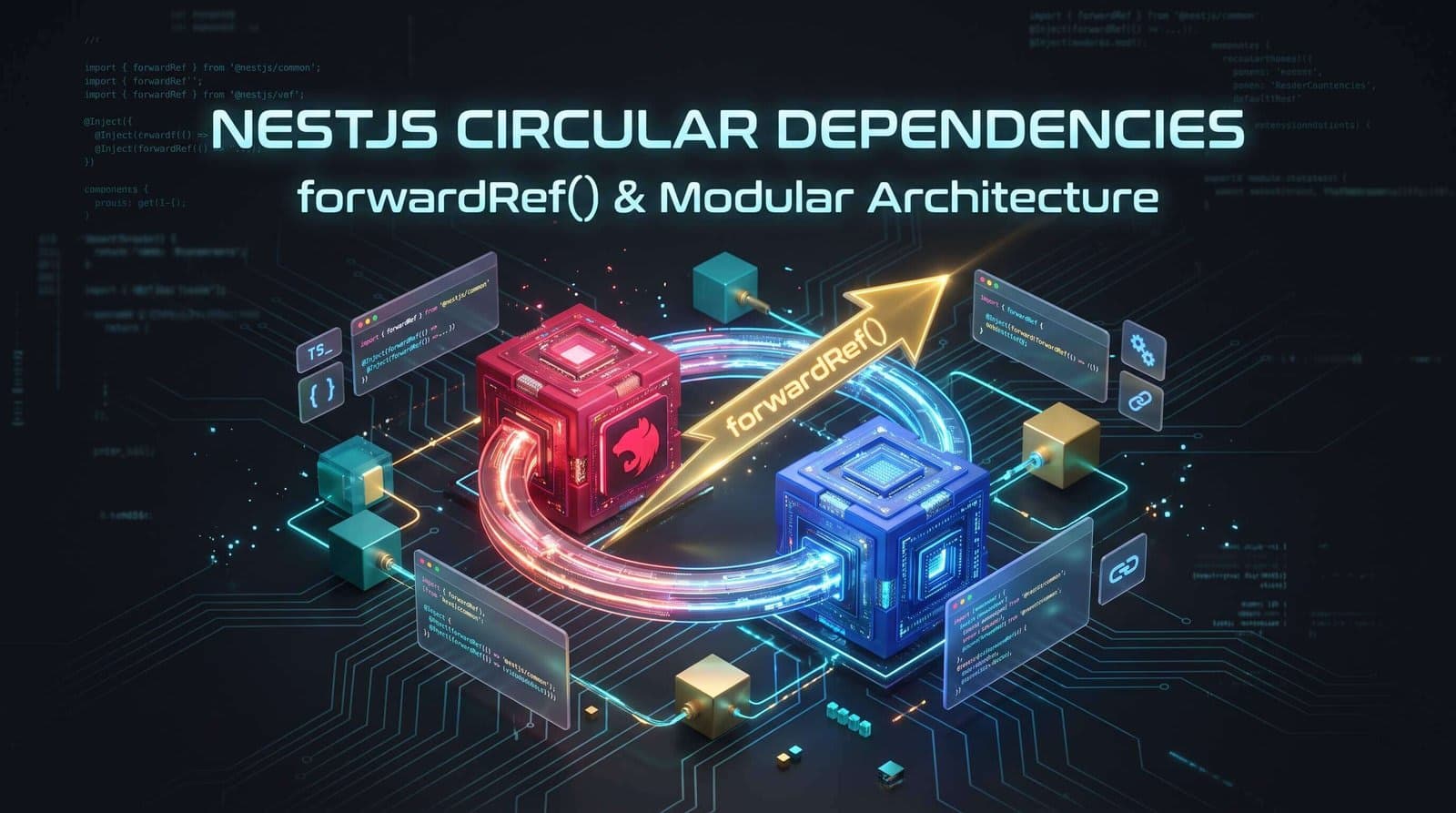
In this comprehensive technical guide, I dig deep into circular dependencies within modular NestJS architecture. Drawing directly from real-world modular applications like CodeOps AI (my AI Software Engineering Workspace project), I break down what circular dependencies are, why Barrel Files (index.ts) trigger them in TypeScript, how forwardRef() work internally under the hood for both services and modules, and clean architectural patterns to prevent them altogether.
Diagnose Circular Dependencies: Understand how circular references break NestJS Dependency Injection (DI) during module scanning and graph compilation.
Identify Barrel File Pitfalls: Recognize how importing from index.ts barrel files creates stealth circular imports resulting in 'undefined' class references.
Master forwardRef() Internal Mechanics: Examine how JavaScript closures and lazy evaluation wrappers allow NestJS to defer token resolution until runtime.
Resolve Service & Module Loops: Apply forwardRef() and ModuleRef lazy getters to resolve interdependent domain providers and feature modules.
Refactor Modular Boundaries: Apply Domain-Driven Design (DDD) principles and event-driven messaging to keep modular boundaries clean.
To understand how circular dependencies arise naturally in a modular monolithic codebase, consider a common e-commerce domain workflow:
OrdersService (inside OrdersModule) needs InventoryService to reserve stock whenever a customer places a new order.
InventoryService (inside InventoryModule) needs OrdersService to automatically create a re-order task or flag an order when stock falls below critical thresholds.
When NestJS attempts to instantiate OrdersService, it discovers it needs InventoryService. But to instantiate InventoryService, it needs OrdersService! Without explicit lazy resolution, NestJS cannot construct the dependency tree, reflect metadata, or resolve constructor tokens, leading to an undefined provider exception during startup.
In NestJS, the Inversion of Control (IoC) container builds a Directed Acyclic Graph (DAG) during bootstrap to resolve dependencies in order. A circular dependency occurs when Class A depends on Class B, and Class B directly or indirectly depends on Class A. When this loop occurs, TypeScript transpile-time evaluation returns undefined for one of the classes because ES module evaluation hasn't finished instantiating the required constructor token.
Circular Dependency Level | Root Cause Mechanism | Resolution Strategy |
Provider Level (@Injectable) | Two domain services inject each other into constructor parameters. | forwardRef(() => Service) or ModuleRef.get() |
Module Level (@Module) | Two feature modules import each other inside their | forwardRef(() => Module) on both sides |
forwardRef() Works InternallyTo understand why forwardRef() solves circular dependency errors, we must examine how JavaScript runtime module loading and NestJS metadata reflection operate.
In TypeScript/JavaScript ES modules, when OrdersService imports InventoryService, Node.js executes inventory.service.ts. But if inventory.service.ts simultaneously imports OrdersService, the OrdersService class token has not yet been defined in memory. Consequently, JavaScript assigns undefined to the imported class symbol at decorator metadata evaluation time.
forwardRef(): The Closure WrapperThe forwardRef() utility function from @nestjs/common is deceptively simple. Its underlying implementation looks like this:
// Simplified internal implementation of forwardRef
export const forwardRef = (fn: () => any) => ({
  forwardRef: fn,
});
Instead of evaluating the class symbol immediately (which returns undefined), forwardRef() wraps the class reference inside an arrow function closure (() => TargetClass).
forwardRef() at RuntimeNestJS handles forwardRef() differently across services and modules during bootstrap:
For Services (Constructor Providers): When @Inject(forwardRef(() => InventoryService)) is attached to a constructor parameter, NestJS stores the closure wrapper instead of trying to resolve the type token immediately. During the IoC container's instantiation phase—after all classes have been loaded into memory—NestJS executes the stored forwardRef callback. The closure returns the fully defined InventoryService class symbol, allowing NestJS to resolve and inject the instance.
For Modules (imports array): During application module scanning (DependenciesScanner), when NestJS encounters forwardRef(() => InventoryModule) inside @Module({ imports }), it defers module metadata extraction. After the initial module graph scan completes, NestJS unwraps the closure function to retrieve the actual module class token, dynamically linking the two module nodes in the application graph.
index.ts Export Anti-Pattern)A frequent and hard-to-detect source of circular dependencies is the use of 'barrel files' (index.ts files used to group exports from a directory). In TypeScript, barrel files aggregate exports for clean import statements. However, importing files through a barrel file within the same feature module creates internal circular loading loops.
Consider this common folder layout and anti-pattern:
// accounts/index.ts (Barrel File)
export * from './interfaces';
export * from './accounts.module';
export * from './accounts.service';

// invitations.module.ts
import { Module } from '@nestjs/common';
import { AccountsModule } from '../accounts'; // ❌ IMPORTED VIA BARREL FILE!

@Module({
  imports: [AccountsModule],
})
export class InvitationsModule {}
When Node.js resolves ../accounts, it evaluates index.ts, which attempts to export AccountsModule and AccountsService before AccountsModule has finished loading its own dependencies. At runtime, TypeScript evaluates AccountsModule as undefined, causing the NestJS scanner to throw:
Error: Nest cannot create the module instance.
Often, this is because of a circular dependency between modules.
Scope [TestModule -> InvitationsModule -> AuthModule]
Golden Rule for Barrel Files
Never use barrel files (index.ts) to import files within the same directory or feature module! Always import directly from the concrete file path (e.g., import { AccountsModule } from '../accounts/accounts.module';).
forwardRef()When two services genuinely require each other, NestJS provides the forwardRef() utility function. forwardRef() allows NestJS to defer class resolution using an indirect reference function until all classes are loaded into memory.
Here is how I resolve service-level circular references between OrdersService and InventoryService:
// orders/orders.service.ts
import { Injectable, Inject, forwardRef } from '@nestjs/common';
import { InventoryService } from '../inventory/inventory.service';

@Injectable()
export class OrdersService {
  constructor(
    @Inject(forwardRef(() => InventoryService))
    private readonly inventoryService: InventoryService,
  ) {}

  async createOrder(orderData: any) {
    // Business logic
    await this.inventoryService.reserveStock(orderData.itemId, orderData.quantity);
  }
}
To complete the resolution, apply forwardRef() symmetrically on the other side:
// inventory/inventory.service.ts
import { Injectable, Inject, forwardRef } from '@nestjs/common';
import { OrdersService } from '../orders/orders.service';

@Injectable()
export class InventoryService {
  constructor(
    @Inject(forwardRef(() => OrdersService))
    private readonly ordersService: OrdersService,
  ) {}

  async checkStockThreshold(itemId: string, remaining: number) {
    if (remaining < 5) {
      await this.ordersService.flagLowStockOrder(itemId);
    }
  }
}forwardRef()When two feature modules need to import each other (for instance, OrdersModule imports InventoryModule and InventoryModule imports OrdersModule), wrap the imported modules in forwardRef() inside both @Module() metadata definitions:
// orders/orders.module.ts
import { Module, forwardRef } from '@nestjs/common';
import { InventoryModule } from '../inventory/inventory.module';
import { OrdersService } from './orders.service';

@Module({
  imports: [forwardRef(() => InventoryModule)],
  providers: [OrdersService],
  exports: [OrdersService],
})
export class OrdersModule {}

// inventory/inventory.module.ts
import { Module, forwardRef } from '@nestjs/common';
import { OrdersModule } from '../orders/orders.module';
import { InventoryService } from './inventory.service';

@Module({
  imports: [forwardRef(() => OrdersModule)],
  providers: [InventoryService],
  exports: [InventoryService],
})
export class InventoryModule {}ModuleRefIf you prefer to avoid forwardRef() or want to break constructor-level coupling entirely, you can inject Nest's built-in ModuleRef class to retrieve provider instances dynamically from the DI container at runtime:
// orders/orders.service.ts using ModuleRef
import { Injectable, OnModuleInit } from '@nestjs/common';
import { ModuleRef } from '@nestjs/core';
import { InventoryService } from '../inventory/inventory.service';

@Injectable()
export class OrdersService implements OnModuleInit {
  private inventoryService: InventoryService;

  constructor(private readonly moduleRef: ModuleRef) {}

  onModuleInit() {
    // Lazily retrieve provider from DI container after modules finish bootstrapping
    this.inventoryService = this.moduleRef.get(InventoryService, { strict: false });
  }

  async processOrder(itemId: string, qty: number) {
    await this.inventoryService.reserveStock(itemId, qty);
  }
}While forwardRef() resolves immediate circular crashes, heavy reliance on it often signals an underlying architectural design flaw. In CodeOps AI, I follow these structural patterns to eliminate circular dependencies cleanly:
Extract Shared Interfaces & Common Modules: If Module A and Module B share helper methods or interfaces, extract the shared logic into a dedicated CommonModule or SharedModule that both modules import independently.
Adopt Event-Driven Architecture (@nestjs/event-emitter): Instead of InventoryService directly calling OrdersService, emit domain events (e.g., this.eventEmitter.emit('stock.low', payload)). The OrdersService listens for the event asynchronously without needing a direct service dependency.
Strict Import Path Verification: Configure ESLint import rules or path aliases in tsconfig.json to prevent importing across feature module boundaries via barrel files.
To test module resolution, verify type safety, and validate dependency graphs under Yarn:
# Start dev server with watch mode to check bootstrap lifecycle
yarn start:dev

# Run ESLint to detect circular imports and barrel file violations
yarn lint

# Run integration e2e tests across module boundaries
yarn test:e2e
Join the Discussion & Share Your Feedback
I’d love to hear your thoughts on this architecture! How are you handling circular dependencies in your own project? Drop your feedback, questions, or experiences in the comment section below.
Circular dependencies in modular NestJS occur when providers or modules form tight, cyclical reference loops, frequently triggered by TypeScript barrel file (index.ts) re-exports. By leveraging forwardRef()—which wraps class symbols in lazy closure callbacks—and ModuleRef, NestJS defers token evaluation until runtime. However, extracting shared services or adopting event-driven architecture remains the cleanest long-term solution.
Comments