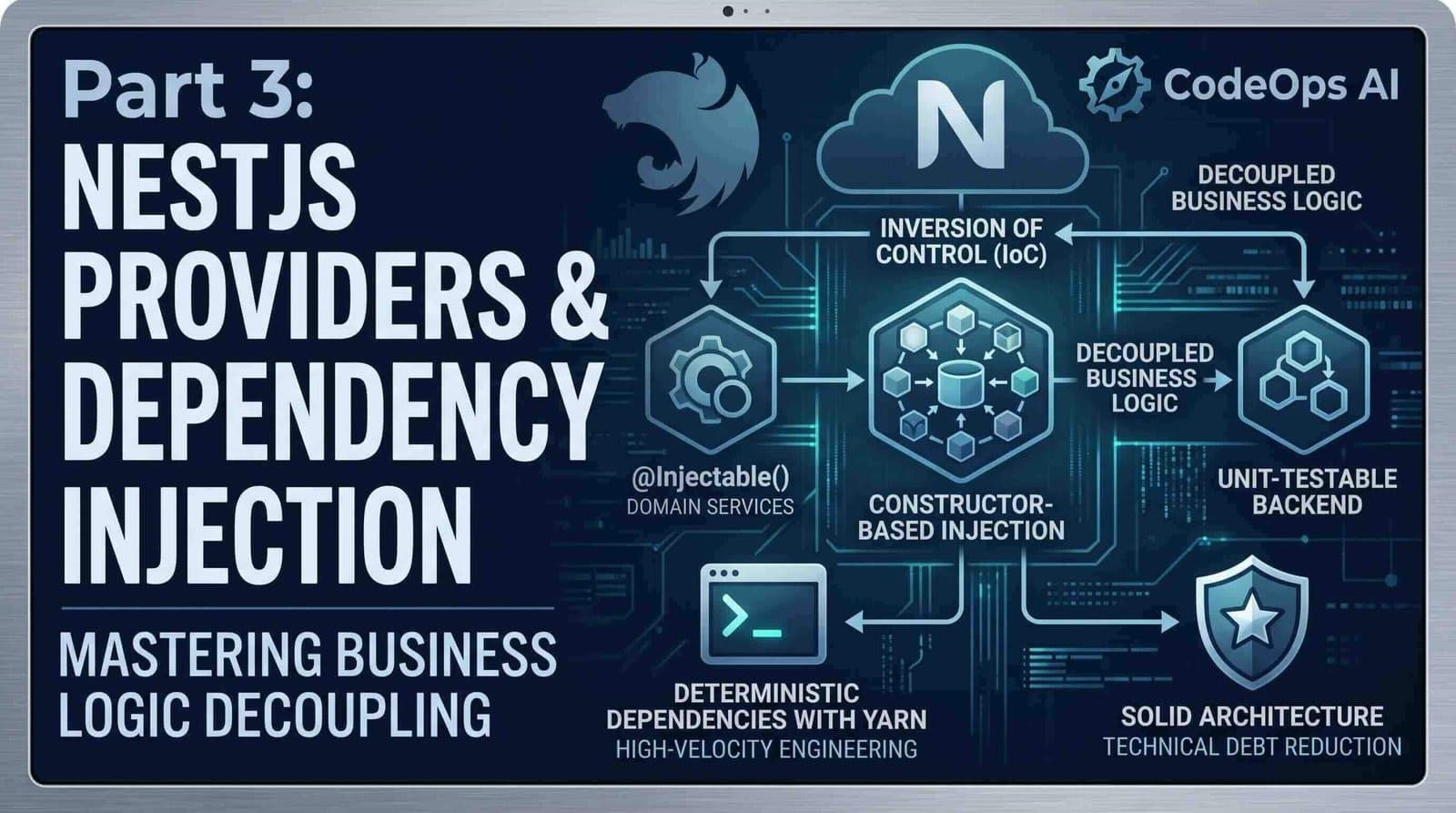
NestJS Providers & Dependency Injection — Mastering Business Logic Decoupling


Mr. Roy
Published about 2 months ago

Discover curated collections of blog posts
Mr. Roy
Published about 2 months ago
Strategic Writer
A technology and business leader with a strong focus on digital transformation, software delivery, and strategic growth. Experienced in leading JavaScript-focused teams, driving business development initiatives, and building innovative SaaS products. Passionate about AI-powered solutions, product development, stakeholder management, and creating scalable digital platforms. Skilled at bridging the gap between business objectives and technology execution while fostering collaboration across clients, teams, and partners.
Get personalized recommendations based on your reading history and interests. Visit the member dashboard to see blogs tailored just for you.
In backend engineering, the fastest path to unmaintainable code is tightly coupling your transport layer with your core domain logic. When controllers instantiate their own dependencies or handle data persistence directly, unit testing becomes nearly impossible, and refactoring risks breaking production.
In this article, I take a deep dive into NestJS Providers—the fundamental engine driving backend business logic. I will architect the execution service layer for CodeOps AI (my AI Software Engineering Workspace), exploring Inversion of Control (IoC), constructor-based dependency injection, custom tokens, and provider scoping using Yarn as a standard toolchain.
Encapsulate Domain Logic via @Injectable(): Declare reusable service providers managed automatically by the NestJS Inversion of Control (IoC) container.
Leverage Constructor Dependency Injection: Inject services cleanly into consumers using TypeScript type hints and constructor access modifiers.
Configure Provider Lifecycles & Scopes: Evaluate Default Singleton, Request-scoped, and Transient provider lifetimes.
Implement Advanced Custom Providers: Inject dynamic options, factory providers, and optional dependencies (@Optional, @Inject).
Providers are a core concept in NestJS that encompass basic classes such as services, repositories, factories, and helpers. The core idea is that a provider can be injected as a dependency, creating clear relationship graphs between components. Nest handles wiring these objects together during application bootstrapping.
Generate a domain service using the Nest CLI and Yarn:
# Scaffold tasks service using Nest CLI with Yarn
yarn nest g service tasksThe @Injectable() decorator attaches metadata to the class, telling Nest's IoC container that this service can be instantiated and managed automatically. Below is the domain logic provider for CodeOps AI tasks:
// tasks.service.ts
import { Injectable } from '@nestjs/common';
import { Task } from './interfaces/task.interface';
import { CreateTaskDto } from './dto/create-task.dto';

@Injectable()
export class TasksService {
  private readonly tasks: Task[] = [];

  create(createTaskDto: CreateTaskDto): Task {
    const newTask: Task = {
      id: `task_${Date.now()}`,
      ...createTaskDto,
      status: 'queued',
      createdAt: new Date(),
    };
    this.tasks.push(newTask);
    return newTask;
  }

  findAll(): Task[] {
    return this.tasks;
  }
}In the consumer controller, we inject TasksService via the constructor. Using the private readonly modifier automatically declares and initializes the property in a single line:
// tasks.controller.ts
import { Controller, Get, Post, Body } from '@nestjs/common';
import { TasksService } from './tasks.service';
import { CreateTaskDto } from './dto/create-task.dto';

@Controller('tasks')
export class TasksController {
  constructor(private readonly tasksService: TasksService) {}

  @Post()
  async create(@Body() createTaskDto: CreateTaskDto) {
    return this.tasksService.create(createTaskDto);
  }

  @Get()
  async findAll() {
    return this.tasksService.findAll();
  }
}Understanding provider lifetimes is critical for memory optimization and state safety:
Injection Scope | Instance Lifetime | CodeOps AI Use Case |
DEFAULT (Singleton) | Instantiated once at bootstrap and shared across the entire application. | Stateless services like TasksService, database pools, and caches. |
REQUEST | A new instance is created for every incoming HTTP request and garbage collected after response. | Tenant-aware context providers, request-specific logging, or per-user state. |
TRANSIENT | A unique instance is created for every consuming class that injects it. | Isolated helper utilities requiring non-shared state across sub-components. |
When building modular enterprise apps, dependencies are sometimes optional or bound to custom string tokens instead of class references:
import { Injectable, Optional, Inject } from '@nestjs/common';

@Injectable()
export class AgentEngineService {
  constructor(
    @Optional() @Inject('AI_ENGINE_CONFIG') private readonly options?: Record<string, any>
  ) {}
}To make a provider available to consumers, register it inside the providers array of your target module:
// app.module.ts
import { Module } from '@nestjs/common';
import { TasksController } from './tasks/tasks.controller';
import { TasksService } from './tasks/tasks.service';

@Module({
  controllers: [TasksController],
  providers: [TasksService],
})
export class AppModule {}
SOLID Architectural Principle: Dependency Inversion
High-level modules (Controllers) should not depend on low-level modules; both should depend on abstractions (Services/Interfaces). NestJS Inversion of Control container handles dependency resolution automatically, keeping your code fully testable.
Validate and execute your service tests using Yarn:
# Start local dev server
yarn start:dev

# Run unit tests for services
yarn test

# Lint provider syntax and enforce clean imports
yarn lintOverusing Request-Scoped Providers: Request-scoped providers impact performance because Nest must instantiate trees on every request. Default to singletons unless per-request state is strictly required.
Property Injection Abuse: Avoid using @Inject() at property levels unless extending base classes. Constructor injection clearly declares required dependencies.
Join the Discussion & Share Your Feedback
I’d love to hear your thoughts on this blog! How are you handling this in your own project? Drop your feedback, questions, or experiences in the comment section below
NestJS Providers enable complete decoupling of business logic from HTTP transport layers. By mastering constructor dependency injection and provider scopes, your application remains clean, modular, and easy to unit test.
Comments