Recap: Basic Overview of NestJS — Building Scalable Enterprise Backend


Mr. Roy
Published about 3 hours ago

Discover curated collections of blog posts
Mr. Roy
Published about 3 hours ago
Strategic Writer
A technology and business leader with a strong focus on digital transformation, software delivery, and strategic growth. Experienced in leading JavaScript-focused teams, driving business development initiatives, and building innovative SaaS products. Passionate about AI-powered solutions, product development, stakeholder management, and creating scalable digital platforms. Skilled at bridging the gap between business objectives and technology execution while fostering collaboration across clients, teams, and partners.
Get personalized recommendations based on your reading history and interests. Visit the member dashboard to see blogs tailored just for you.
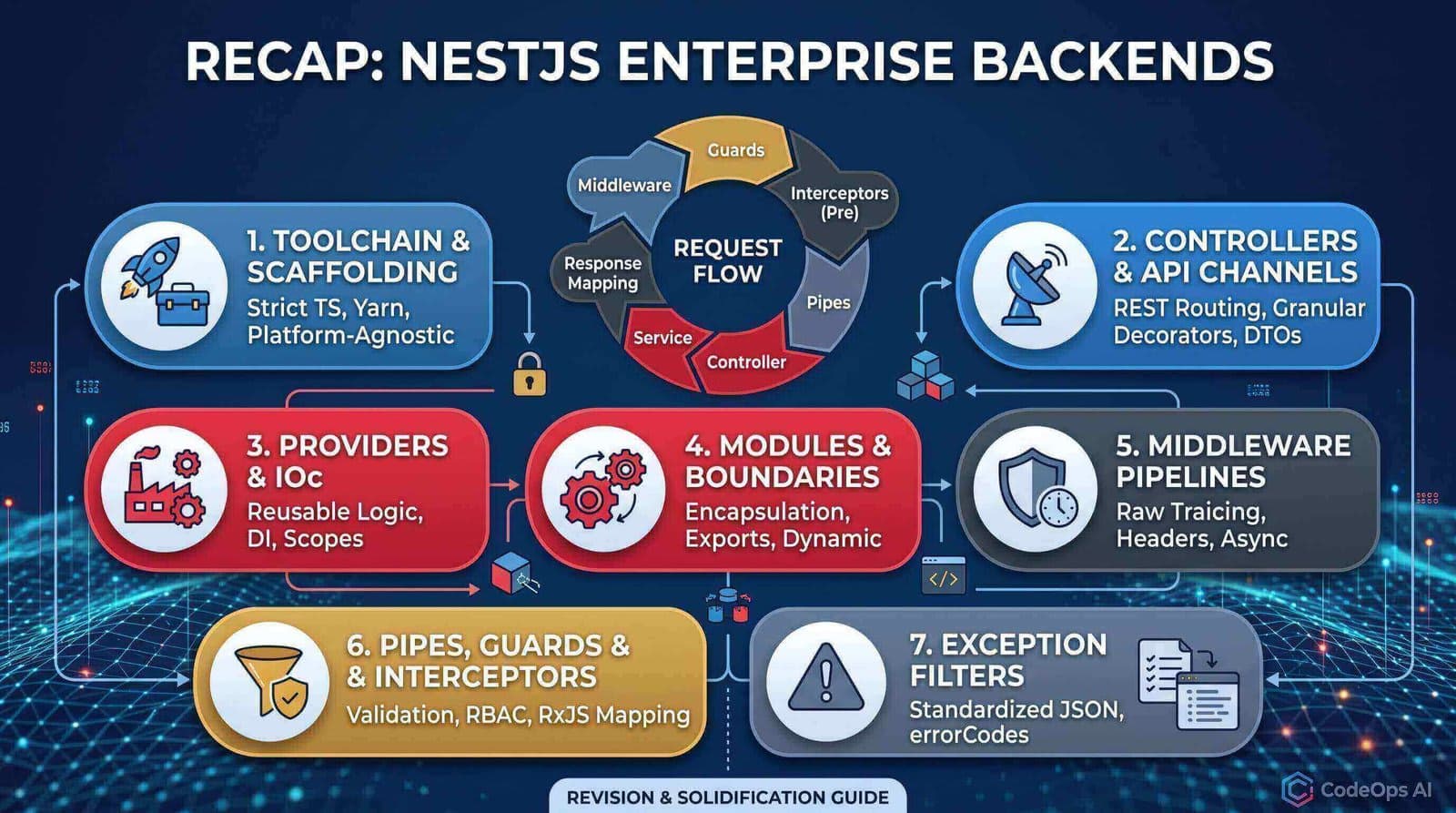
After exploring the core pillars of NestJS across our deep-dive topics, I created this single master recap to give you a fast, high-level revision of the entire architecture. Instead of sifting through code snippets, this guide synthesizes the core theory, structural roles, and key engineering benefits of each concept so you can quickly review and solidify your understanding.
Whether you are designing a new platform like CodeOps AI (my AI Software Engineering Workspace project) or preparing for an architectural discussion, use this revision post to map out how NestJS primitives work together to deliver robust Node.js backend systems.
Topic & Pillar | Core Theoretical Concept | Primary Engineering Benefit |
1. Toolchain & Scaffolding | Deterministic builds with Yarn, strict TypeScript mode, platform-agnostic HTTP adapters. | Prevents runtime null reference crashes and guarantees reproducible builds across CI/CD. |
2. Controllers & Routing | REST routing layer, parameter decorators, ES6 class DTO contracts. | Decouples HTTP transport protocols from domain logic with persistent runtime schemas. |
3. Providers & IoC | @Injectable() domain services, constructor dependency injection, provider lifecycles. | Eliminates tight coupling, simplifies unit testing, and manages memory efficiently via singletons. |
4. Modules & Boundaries | @Module() metadata DAG graph, encapsulated feature domains, dynamic factories. | Establishes clean architectural boundaries and prevents technical debt as teams scale. |
5. Middleware Pipelines | Pre-routing HTTP stream interception with access to raw Request/Response objects. | Centralizes cross-cutting concerns like raw logging, CORS, and header verification. |
6. Pipes, Guards & Interceptors | Deterministic execution pipeline: validation (Pipes), RBAC (Guards), AOP mapping (Interceptors). | Enforces payload integrity, context-aware security, and aspect-oriented stream manipulation. |
7. Exception Filters | Centralized unhandled exception layer with machine-readable error codes. | Delivers predictable, secure JSON error contracts without exposing raw internal stack traces. |
Short Summary: Sets up the initial engineering foundation using strict TypeScript settings and Yarn as the standard package manager.
Theory: NestJS provides a platform-agnostic architecture running on top of an abstraction layer (HTTP adapter). By default, it uses Express for broad ecosystem compatibility, but can be seamlessly swapped to Fastify for ultra-high throughput environments. The main entry file (main.ts) uses NestFactory to bootstrap the application graph.
Key Benefits:
Deterministic Dependencies: Utilizing Yarn lockfiles guarantees identical package installations across local machines and production servers.
Compile-Time Safety: Enabling strict TypeScript flags prevents common production runtime errors like 'cannot read property of undefined'.
Engine Flexibility: Abstracting underlying HTTP engines allows teams to swap adapters without rewriting business controllers.
Short Summary: Governs incoming REST HTTP requests, extracts parameters cleanly, and returns structured API responses.
Theory: Controllers are decorated TypeScript classes linked directly to NestJS routing trees. Instead of manipulating raw platform request objects, controllers use granular decorators (@Body, @Query, @Param) to extract parameters. Payload contracts are declared using ES6 classes (DTOs) so that type metadata persists into the JavaScript runtime.
Key Benefits:
Separation of Transport Concerns: Controllers focus strictly on HTTP routing and parameter binding, leaving business execution to services.
Persistent Contract Metadata: Class-based DTOs maintain field types at runtime, enabling automated validation and API documentation.
Automated JSON Serialization: Nest automatically serializes returned JavaScript objects with proper HTTP status codes, preventing hung connections.
Short Summary: Encapsulates core business logic, database operations, and external integrations into reusable providers managed by an Inversion of Control (IoC) container.
Theory: Any class annotated with @Injectable() can be managed by Nest's IoC container. Consumers inject dependencies via constructor parameters using TypeScript type hints. Providers operate under defined lifecycles: Default (Singleton), Request-scoped, or Transient.
Key Benefits:
Decoupled Domain Logic: Separates core algorithms and business rules from HTTP controllers, keeping code DRY and maintainable.
Effortless Unit Testing: Constructor injection allows easy mocking of dependencies during automated unit tests.
Memory Optimization: Default singleton scoping reuses service instances globally, saving system memory and bootstrap time.
Short Summary: Organizes related controllers and providers into isolated, cohesive domain feature modules.
Theory: A module is a class decorated with @Module() that provides Nest's dependency injector with an application graph (Directed Acyclic Graph). Modules encapsulate internal logic and explicitly define public APIs through their exports array. Configurable modules use dynamic factories (forRoot) to inject runtime options.
Key Benefits:
Strict Encapsulation: Prevents cross-calling internal entities haphazardly, reducing technical debt as teams scale.
Modular Reusability: Feature modules can be exported and reused across multiple microservices within an enterprise workspace.
Dynamic Runtime Configuration: Dynamic modules permit runtime customizations (e.g., database connections) cleanly.
Short Summary: Operates before route handlers are selected to inspect, trace, or modify incoming HTTP request and response streams.
Theory: NestJS middleware is equivalent to Express middleware by default. It has access to raw Request/Response objects and the next() function. Middleware is configured inside module classes implementing NestModule via the MiddlewareConsumer helper.
Key Benefits:
Centralized Pre-processing: Ideal for raw request logging, tenant header verification, body parsing, and CORS policy enforcement.
Flexible Route Targeting: MiddlewareConsumer allows precise targeting of controllers, HTTP verbs, or wildcard paths.
Class & Functional Options: Supports lightweight pure functions alongside full dependency-injected class middleware.
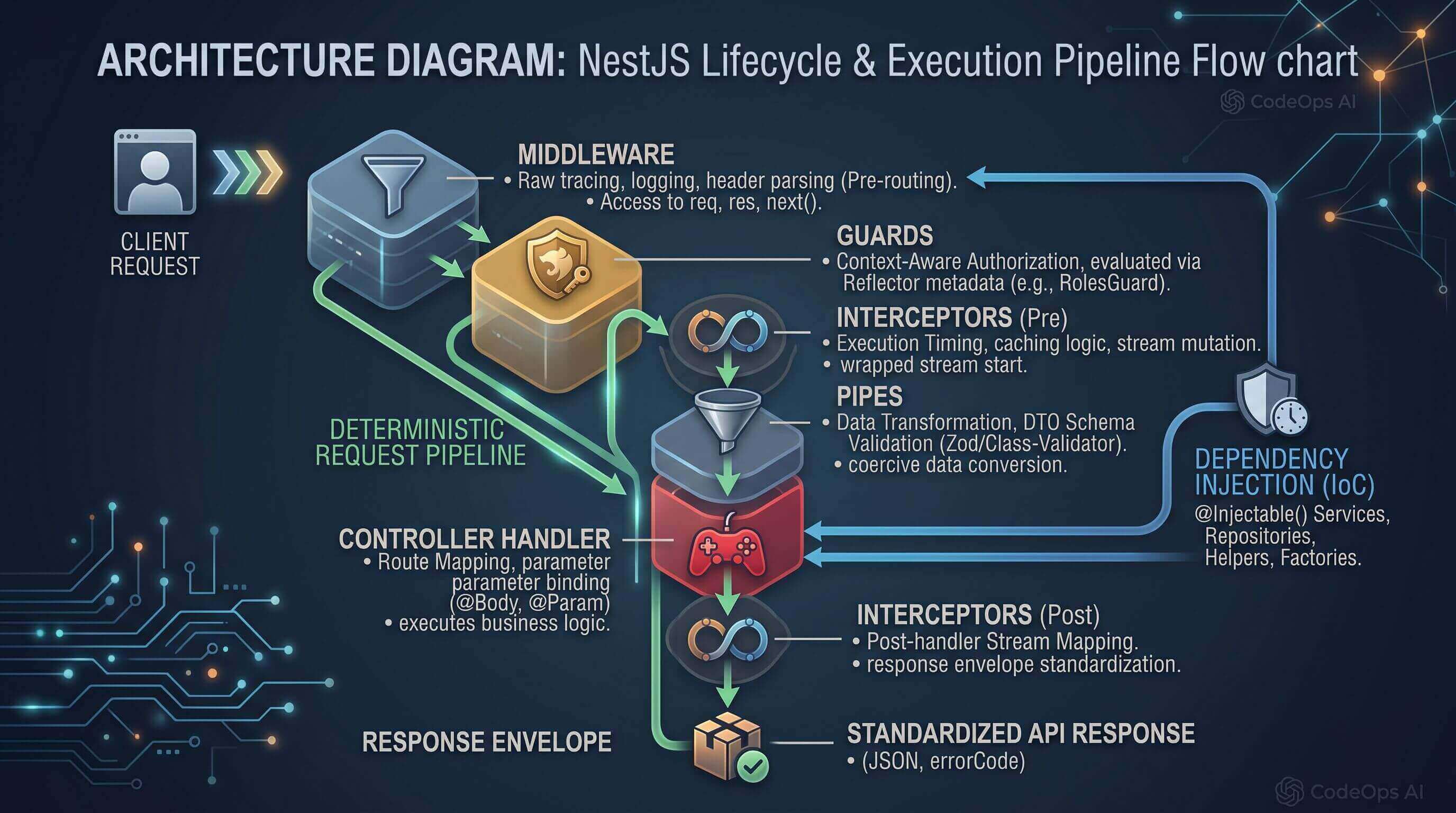
Short Summary: Manages the deterministic post-routing execution sequence: authorization (Guards), stream mapping/caching (Interceptors), and payload validation (Pipes).
Theory: Requests pass through lifecycle components in exact order: 1. Middleware -> 2. Guards -> 3. Interceptors (Pre-handler) -> 4. Pipes -> 5. Route Handler -> 6. Interceptors (Post-handler RxJS mapping). Guards evaluate ExecutionContext for RBAC using Reflector metadata. Pipes transform and validate input arguments. Interceptors utilize Aspect-Oriented Programming (AOP) to wrap execution streams.
Key Benefits:
Context-Aware Security: Guards inspect target controller metadata to grant or deny access before handler invocation.
Runtime Payload Integrity: Pipes validate and coerce incoming data types automatically, rejecting bad payloads early.
Aspect-Oriented Flexibility: Interceptors manipulate response streams, cache results, enforce request timeouts, and standardize JSON envelopes.
Short Summary: Intercepts unhandled errors across the application graph and formats them into predictable, client-friendly error responses.
Theory: Nest features a built-in exceptions layer that processes unhandled exceptions. Custom filters implement ExceptionFilter and @Catch() to override default behavior. By accessing HttpAdapterHost, filters remain platform-agnostic across Express and Fastify adapters. Machine-readable error codes (errorCode) simplify client-side branching.
Key Benefits:
Standardized Client Contracts: Ensures consistent JSON error formats across all microservices, eliminating client integration guesswork.
Information Leak Prevention: Hides internal stack traces and server details in production while preserving internal causes for logging.
Global Dependency Injection: Registering filters via APP_FILTER permits full service injection (Logger, Config) inside error handlers.
Stick to Yarn Toolchain: Maintain deterministic dependency resolution by avoiding mixed package managers (npm/yarn lock conflicts).
Keep Controllers Thin: Delegate business execution entirely to services to preserve Single Responsibility Principle (SRP).
Use Module-Level Global Tokens: Register global pipes, guards, interceptors, and filters via APP_* tokens inside modules to preserve Dependency Injection.
Join the Discussion & Share Your Feedback
I’d love to hear your thoughts on this architecture! How are you handling this in your own project? Drop your feedback, questions, or experiences in the comment section below.
I hope this revision recap gives you a clear, consolidated reference for NestJS enterprise architecture. By combining clean bootstrapping, modular boundaries, context-aware guards, payload validation pipes, aspect-oriented interceptors, and resilient exception filters, you equip your Node.js backends to scale securely and efficiently.
Comments