Solution vs. System Architecture: Deconstructing the Boundary


Mr. Roy
Published about 3 hours ago
0 comments
5 min read

Discover curated collections of blog posts
Mr. Roy
Published about 3 hours ago
Strategic Writer
A technology and business leader with a strong focus on digital transformation, software delivery, and strategic growth. Experienced in leading JavaScript-focused teams, driving business development initiatives, and building innovative SaaS products. Passionate about AI-powered solutions, product development, stakeholder management, and creating scalable digital platforms. Skilled at bridging the gap between business objectives and technology execution while fostering collaboration across clients, teams, and partners.
Get personalized recommendations based on your reading history and interests. Visit the member dashboard to see blogs tailored just for you.
In design review meetings and enterprise architectural discussions, I frequently observe two key technical leaders proposing ideas side by side: a Solutions Architect and a System Architect. Both draw block diagrams, evaluate technical trade-offs, and influence major engineering investments. In practice, many teams conflate these roles, treating them as identical titles.
However, blurring this distinction creates organizational friction and structural inefficiencies. Solution Architecture and System Architecture operate at fundamentally different levels of granularity, abstraction, and decision-making drivers. Understanding where the boundary lies is critical for designing scalable enterprise platforms, establishing clear engineering ownership, and aligning software investments with core business strategy.
Differentiate between outward-facing Solution Architecture and inward-facing System Architecture across the entire technology stack.
Analyze real-world enterprise scenarios using relatable analogies to determine architectural scope and boundaries.
Evaluate key technical trade-offs, stakeholder dynamics, and decision drivers governing both architectural disciplines.
Establish a collaborative, cross-functional engineering framework between Solutions Architects and System Architects.
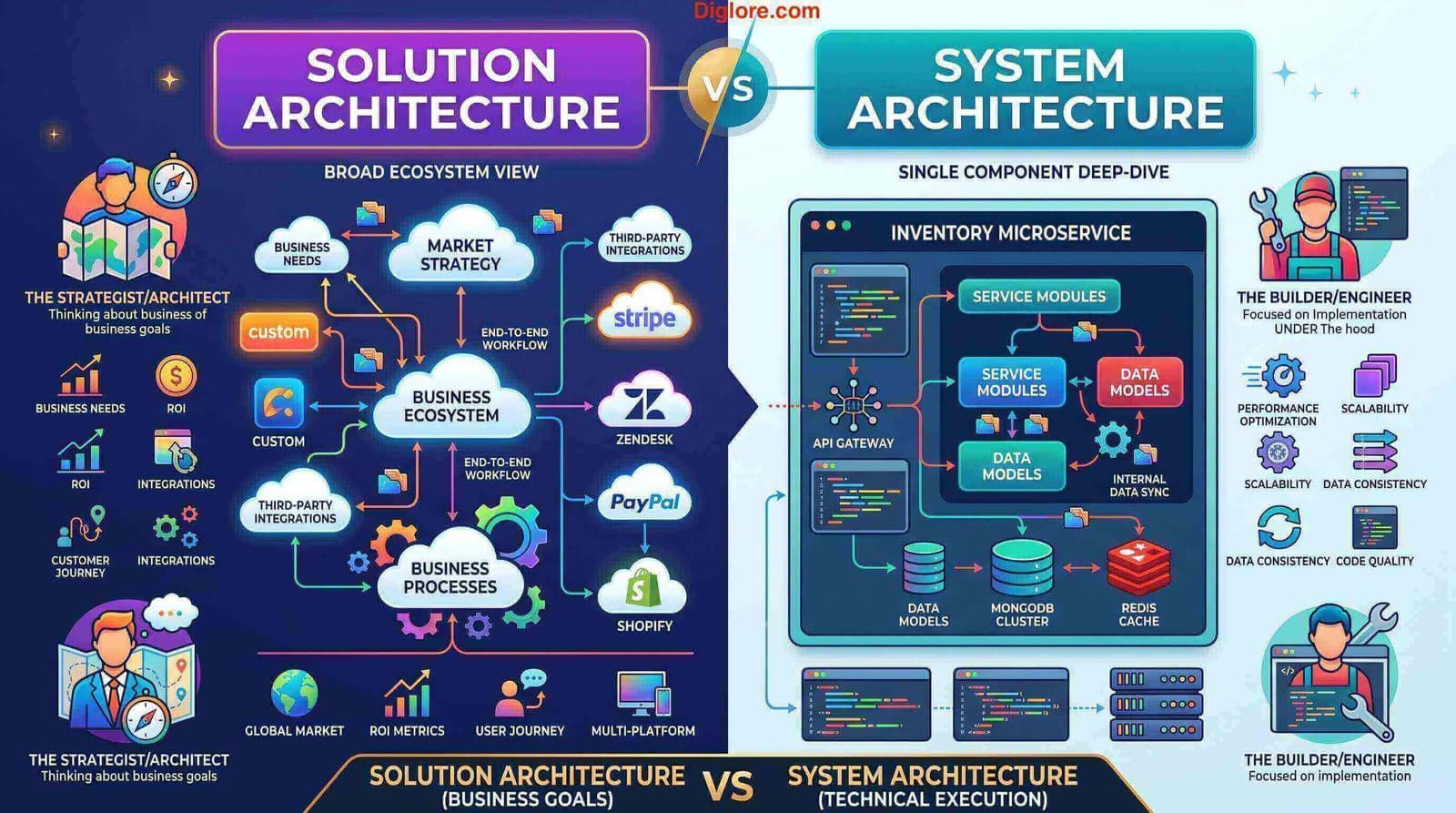
At a fundamental level, Solution Architecture focuses on WHAT business problem needs to be solved and HOW disparate systems, third-party platforms, and cloud workflows assemble to solve it end-to-end. System Architecture, on the other hand, focuses on HOW an individual software platform, service, or infrastructure component is engineered structurally under the hood.
Architectural Dimension | Solution Architecture | System Architecture |
Primary Focus | Business-aligned end-to-end ecosystems | Internal software structure & platform execution |
Level of Abstraction | Macro-level (Systems, SaaS, APIs, Flows) | Micro-level (Modules, Data Schemas, Threads) |
Primary Objective | ROI, Business Outcomes, Strategic Alignment | Performance, Reliability, Scalability, Code Quality |
Key Questions Asked | Which platforms & services fulfill the business goal? | How will the backend service query MongoDB at low latency? |
Key Stakeholders | Product Managers, Executives, Business Analysts | Software Engineers, DevOps Leads, Tech Leads |
Hands-on Coding Scope | Integration, API contracts, Low/No-code glue | High technical depth, design patterns, core implementation |
Primary Technical Stack | NestJS, Next.js, Cloud SaaS, Third-party APIs | NestJS Modules, MongoDB Schemas, Mongoose, Redis |
To make this distinction clear, I often use the real-world analogy of constructing a modern digital medical facility:
Solution Architecture Perspective: The Solution Architect designs the hospital ecosystem. I map out how the patient mobile check-in app connects to third-party insurance billing systems, how lab result alerts trigger automated notifications to doctors' tablets, and how prescription orders route to the pharmacy platform. I focus on end-to-end operational flow, security boundaries, and overall business value.
System Architecture Perspective: The System Architect focuses directly on the patient check-in application itself. I decide whether the backend runs on NestJS with microservices, how MongoDB indexes patient records for sub-millisecond lookups, and how local memory caching prevents server crashes during high morning check-in traffic.
In practice, I frequently apply these principles when architecting web applications using NestJS, Next.js, and MongoDB. Here is how both architectural responsibilities split when engineering an enterprise e-commerce ecosystem.
From a Solution Architecture standpoint, I define the integration boundary between custom applications, cloud hosting, and third-party payment gateways:
// High-Level Solution Architecture Blueprint
[ Next.js Web Storefront ] ---> [ AWS CloudFront / Vercel ]
          │
          ├---> [ NestJS Core API Gateway ] ---> [ Stripe / Payment Gateway API ]
          │
└---> [ MongoDB Atlas Cluster ] <--- [ Inventory Event Consumer Service ]From a System Architecture standpoint, I dive into the internal application design, implementing NestJS dependency injection and Mongoose database schema optimizations to handle heavy write volume safely:
// System Architecture: NestJS Order Processing Service
@Injectable()
export class OrderProcessingService {
  constructor(
    @InjectModel(Order.name) private readonly orderModel: Model<OrderDocument>,
    private readonly redisCacheService: RedisCacheService,
  ) {}

  async processOrder(createOrderDto: CreateOrderDto): Promise<Order> {
    // System-level optimization: Atomic transaction with MongoDB session
    const session = await this.orderModel.db.startSession();
    session.startTransaction();
    try {
      const order = new this.orderModel(createOrderDto);
      await order.save({ session });
      await this.redisCacheService.invalidate(`inventory:${createOrderDto.itemId}`);
      await session.commitTransaction();
      return order;
    } catch (error) {
      await session.abortTransaction();
      throw new SystemExecutionException('Order transaction failed', error);
    } finally {
      session.endSession();
    }
  }
}In a mature engineering organization, these two roles do not operate in isolated silos; they create a continuous operational feedback loop.
1. Solution Architecture Establishes Boundaries: I set project goals, budget constraints, third-party SLA expectations, and system integration contracts.
2. System Architecture Drives Execution: I design internal component interfaces, data consistency models, and high-concurrency throughput strategies.
3. Bidirectional Technical Feedback: If I discover during system implementation that a specific database locking mechanism introduces unacceptable latency, I feed this technical constraint back to the Solution Architect to adjust higher-level SLAs or integration patterns.
Neither Solution Architecture nor System Architecture is superior—they are complementary perspectives necessary for software excellence. Solution Architecture ensures that engineering teams build the right solution to deliver tangible business ROI. System Architecture ensures that the underlying software is built right—guaranteeing high availability, sub-second performance, and long-term maintainability.
When organizations respect this distinction, projects avoid two common failure modes: building over-engineered internal systems that fail to deliver business value, or building poorly structured software that collapses under production scale. By fostering seamless collaboration between ecosystem design and component engineering, engineering leaders can deliver resilient, scalable, and business-driven technology platforms.
Comments