The 3-Part Strategy Audit: Is Your Plan a Strategy or a To-Do List?


Mr. Roy
Published 3 months ago
0 comments
3 min read
Discover curated collections of blog posts
Mr. Roy
Published 3 months ago
Strategic Writer
A technology and business leader with a strong focus on digital transformation, software delivery, and strategic growth. Experienced in leading JavaScript-focused teams, driving business development initiatives, and building innovative SaaS products. Passionate about AI-powered solutions, product development, stakeholder management, and creating scalable digital platforms. Skilled at bridging the gap between business objectives and technology execution while fostering collaboration across clients, teams, and partners.
Get personalized recommendations based on your reading history and interests. Visit the member dashboard to see blogs tailored just for you.
Most leadership teams confuse motion with progress. We spend weeks building massive slide decks and alignment templates, only to realize our teams are still running in a thousand different directions simultaneously.
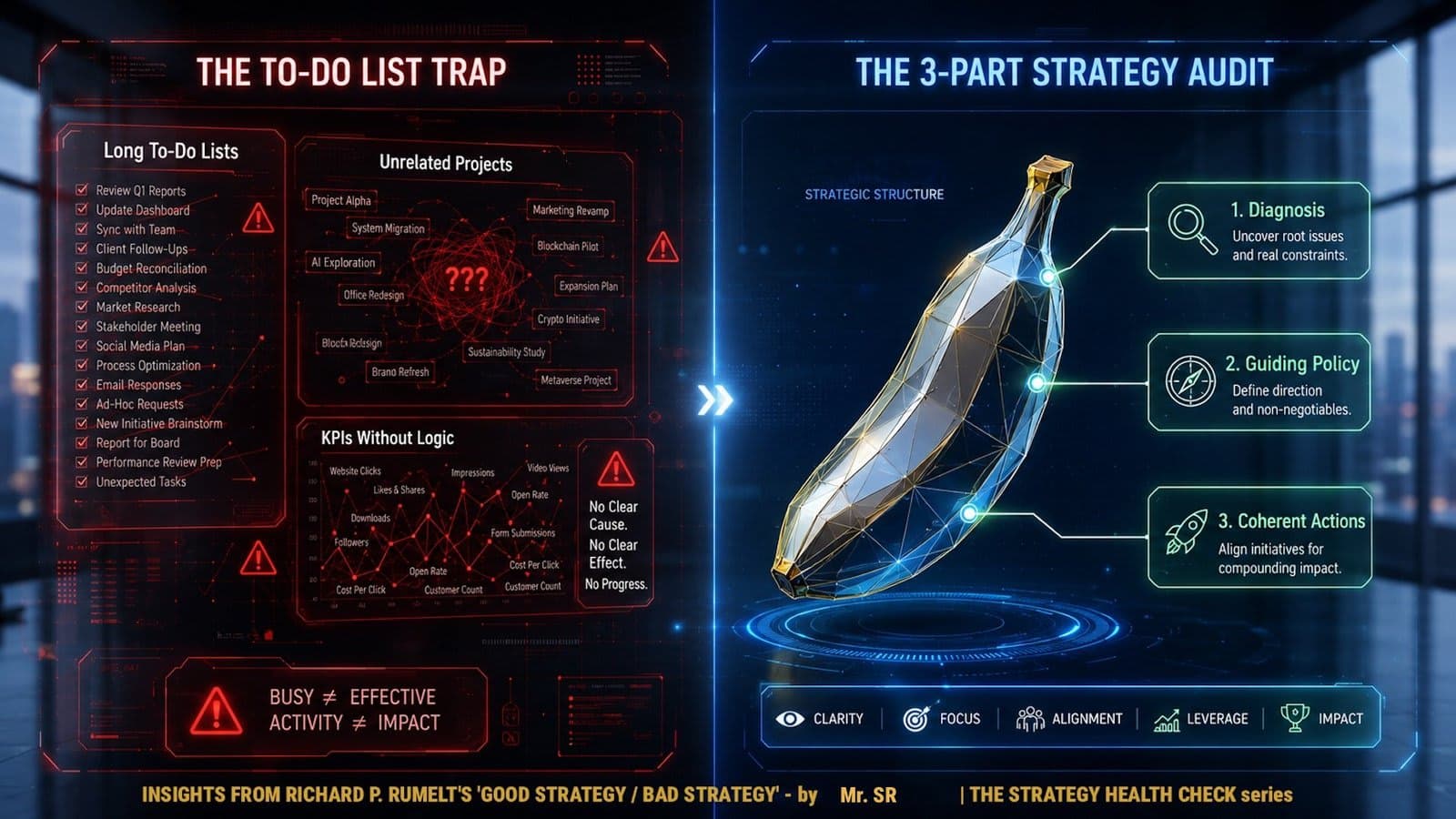
In his foundational work Good Strategy / Bad Strategy, Richard Rumelt notes that real strategic power comes from stripping away the noise to focus your resources on a single point of leverage. To move from abstract corporate frameworks to clean execution, use this quick reference blueprint to check if your current planning stands up to the requirements of a real strategic Kernel.
This is the most underappreciated part of strategy—and the most vital.
What it is: A clear explanation of the challenge that identifies what really matters and filters out what can be ignored.
Key Question: "What is actually going on here?"
What it does: Simplifies a complex corporate reality into a sharp problem statement by pinpointing critical constraints and root causes rather than symptoms.
What it is NOT: A goal, a vision, or a messy list of disconnected problems.
Example: Instead of saying "Sales are down," a good diagnosis states: "Our cost structure makes us uncompetitive in mid-market deals where price sensitivity is high."
This represents your strategic logic—the "rule of thumb" for the battlefield.
What it is: An overall approach for dealing with the diagnosed challenge that explicitly defines what you will and will NOT do.
Key Question: "Given this diagnosis, how will we compete or act?"
What it does: Narrows choices and channels energy and resources to create total coherence across all decisions.
What it is NOT: A mission statement, vague positioning, or generic advice like "be customer-centric."
Example: "We will focus only on enterprise clients where compliance complexity is high and price sensitivity is low."
This is where most "strategies" fail because they skip the first two steps.
What it is: A coordinated set of actions where each step directly reinforces the guiding policy so they fit together as a unified whole.
Key Question: "What must we actually do—consistently—to execute this policy?"
What it does: Implements clear operational trade-offs, drives intense resource concentration, and enforces strict prioritization.
What it is NOT: Long to-do lists, unrelated projects, or vanity KPIs without strategic logic.
Example: Investing heavily in senior solution architects and exiting low-margin SMB projects entirely to back up your enterprise-only policy.
Before you sign off on your next planning cycle, ask yourself these two brutal questions to finalize your audit:
If your strategy requires you to say "yes" to every opportunity, do you actually have a strategy at all?
What is the one hard choice you are currently avoiding that is holding your strategy back?
Real results do not come from spending more or trying harder. They come from having the courage to simplify, the discipline to subtract, and the clarity to focus power where it matters most.
This article is part of The Strategy Health Check series, adapted from the core architectural principles of Richard P. Rumelt’s business masterwork, Good Strategy / Bad Strategy. For deep-dive case studies on how Apple, SpaceX, and NVIDIA apply these rules in the real world, read Part 1: Beyond the To-Do List: Building a Strategy That Actually Wins
Comments